Office Ergonomics: What Business Class Can Teach You
- Peter P
- 4 days ago
- 3 min read

Imagine you're about to board a 14-hour flight.
You have two options.
The first is an economy seat. Your knees are close to the seat in front, your elbows compete for armrests, and after a few hours you find yourself constantly shifting position to get comfortable.

The second is business class. There's more room to stretch out, the seat reclines, you can adjust your position throughout the flight, and your body doesn't have to work nearly as hard just to stay comfortable.
Even if you've never flown business class (I haven't), it's easy to imagine which seat you'd rather spend the next 14 hours in.
Interestingly, the lesson isn't really about flying - It's about how we think about neck pain.
Many people believe the answer is finding the "perfect posture." But just like the difference between economy and business class, comfort isn't usually about one perfect position - it's about reducing strain, having room to move, and changing positions regularly.
More Than Just Comfort
So what actually makes business class more comfortable?
It isn't that the seats somehow "fix" your posture and reduces neck pain from sitting.
It's that they reduce the physical demands placed on your body.
Business class gives you:
More room to move.
Better support for your back and arms.
The ability to recline and change position.
Less pressure on any one part of your body.
In contrast, economy often limits your ability to move. Your neck, shoulders and back can end up doing more work simply because your body has fewer options.
The longer you're in one position, the more noticeable that discomfort becomes.
Your workstation works in much the same way.
What This Means at Your Desk - Office Ergonomics
Many people spend seven or eight hours each day sitting at a computer.
When neck pain develops, it's common to blame "bad posture."
You've probably heard advice like:
Sit up straight.
Pull your shoulders back.
Tuck your chin in.
Never slouch.
While these cues can be helpful for short periods, trying to maintain a perfectly upright posture all day is unrealistic. Your muscles fatigue, your attention shifts, and before long you've drifted into another position.

That isn't because you're stuck in bad habits
It's because your body was never designed to stay completely still.
The Goal Isn't Perfect Posture
One of the biggest myths surrounding neck pain is that there is a single "correct" posture.
The reality is that no posture remains comfortable forever.
Even the most ergonomic chair becomes uncomfortable if you stay in it long enough.
The aim isn't to hold one perfect position all day. It's to create a setup that reduces unnecessary strain and allows you to move regularly.
Think back to our airplane analogy.
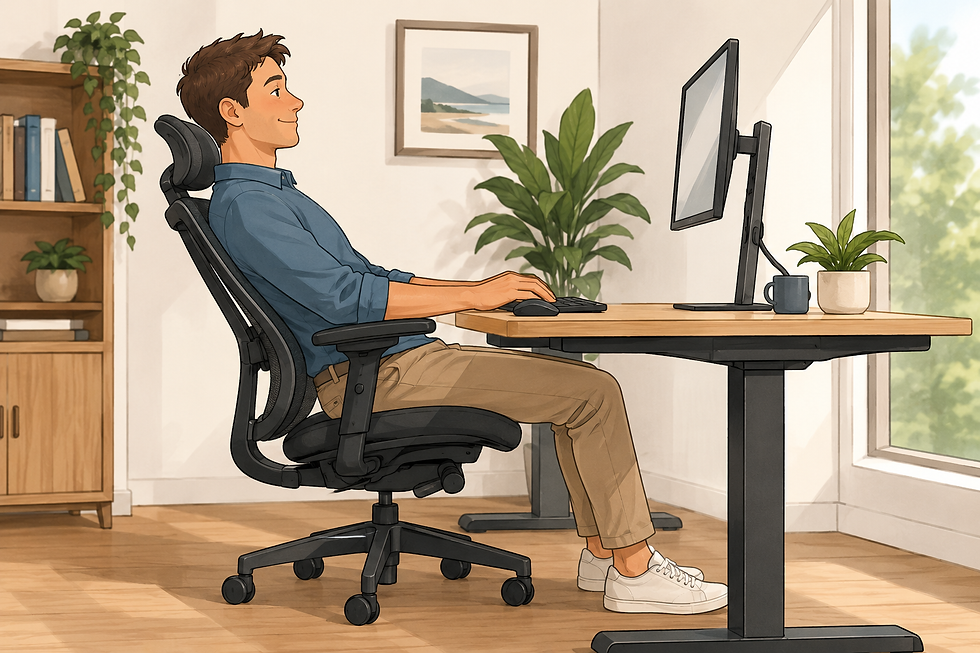
Business class isn't comfortable because passengers sit perfectly for fourteen hours.
It's comfortable because the environment makes it easier to distribute the workload across different muscles and joints. You can recline, stretch, adjust your seat and change position with ease.
Your office ergonomics should do exactly the same.
How to Improve Your Office Ergonomics
Adjust your chair so your elbows rest around 90°. Have a slight recline rather than being perfectly straight.
Position your monitor roughly at eye level.
Keep frequently used items within easy reach.
Change your position every 30–60 minutes.
Get up and walk for a minute or two throughout the day.
Key Take Away
Business class isn't comfortable because it magically protects your spine.
It's comfortable because it reduces strain and gives you the freedom to move.
Your workstation should aim to do the same.
A well-designed ergonomic setup can shift load away from tired muscles, making it easier to work comfortably for longer. But even the best chair can't replace movement.
The goal isn't to find one perfect posture. It's to reduce unnecessary strain, vary your position throughout the day, and keep your body moving.
After all, if you stayed perfectly still in business class for 14 hours, you'd still get stiff.
Your body wasn't designed to stay in one position - it was designed to move.


